NEC4 clause 61.3: the eight-week time bar
Why the date you became aware of an event matters more than the date you priced it, and how to keep your entitlement to time and money.
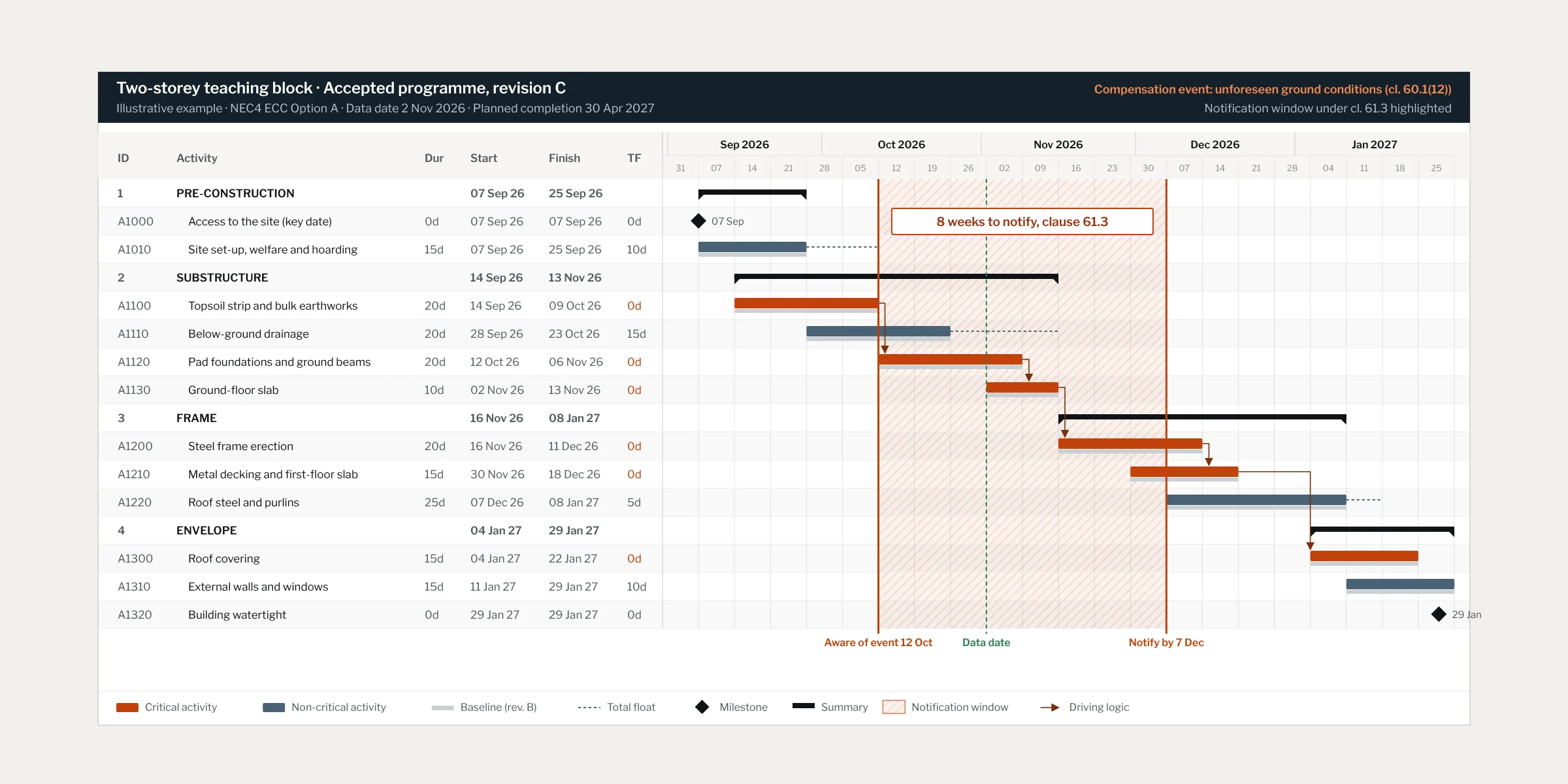
What clause 61.3 says
Under the NEC4 Engineering and Construction Contract, many compensation events are notified by the Project Manager. Clause 61.3 covers the rest. If the Contractor believes an event is a compensation event and the Project Manager has not notified it, the Contractor notifies it.
The clause then sets a deadline. If the Contractor does not notify the event within eight weeks of becoming aware that it has happened, the Contractor is not entitled to a change in the Prices, the Completion Date or a Key Date. In plain terms: miss the eight weeks and you can lose both the time and the money, however strong the underlying case.
NEC3 has a similar provision, and many contracts amend it, so the starting point is always the clause in your own contract.
When the eight weeks start
The trigger is awareness that the event has happened, not the moment you have worked out its cost or its effect on the programme. A site team that knows on Monday that unexpected services have been found has, in practice, started the clock on Monday, even if the commercial team hears about it a month later.
The clock starts when you become aware the event has happened, not when you have worked out what it costs.
That is why the time bar catches so many contractors. The notice itself is short and simple. What goes wrong is the gap between the people who see the event and the people who notify it.
Events excluded from the time bar
The time bar does not apply to every event. Certain events, such as those arising from a Project Manager's instruction, are excluded from the time bar; check the clause in your contract for the full list and its exact wording. If you are relying on an exclusion, record why it applies at the time, rather than arguing it later.
Where the Project Manager should have notified an event and did not, it is still sensible to notify it yourself. A notice costs little; a lost entitlement can cost a great deal.
Early warnings are a separate duty
Clause 15 deals with early warnings, which are not the same thing as compensation event notices. An early warning is about a matter that could increase cost, delay completion or affect the works, and it is meant to prompt a conversation about how to reduce the problem.
The two interact. If the Project Manager decides that an experienced contractor could have given an early warning and did not, that can reduce the assessment of the related compensation event: it is assessed as if the early warning had been given (clauses 61.5 and 63.7). Give early warnings promptly, and keep them separate from your compensation event notices.
Your programme is part of the evidence
Clause 32 requires the Contractor to submit revised programmes showing, among other things, actual progress and the effects of implemented compensation events. An accepted programme that reflects reality is the baseline against which delay is assessed. A programme that has not been revised for months makes every time claim harder to support, even when the notices were on time.
Once an event is notified, the contract also sets timescales for the Project Manager's reply. If the Project Manager does not reply in time, clause 61.4 sets out how the Contractor can notify the failure and what follows. Diarise those dates as carefully as your own.
Practical steps
- Keep a single compensation event register for the contract, with the date each event was first known on site.
- Diarise the awareness date and the eight-week deadline for every event the moment it is logged.
- Make it easy for site staff to report events the same day: a short form or message is enough.
- Notify promptly. The notice can be brief; the quotation and the detail follow under the contract's own timescales.
- Keep contemporaneous records: dated photos, diaries, emails and instructions made at the time carry far more weight than recollection.
- Revise the programme at the intervals the Contract Data requires, and show the effect of each implemented event.
Check your amendments
Many NEC contracts carry Z clauses that change the time bar, shorten it, add conditions or change who notifies what. Read clause 61.3 together with the Contract Data and any Z clauses before relying on the standard wording, and check again for any lower-tier contract that sits under a main contract with different terms.
This is general guidance, not legal advice. Contracts differ and are often amended, so check your own contract and take advice on your specific circumstances.